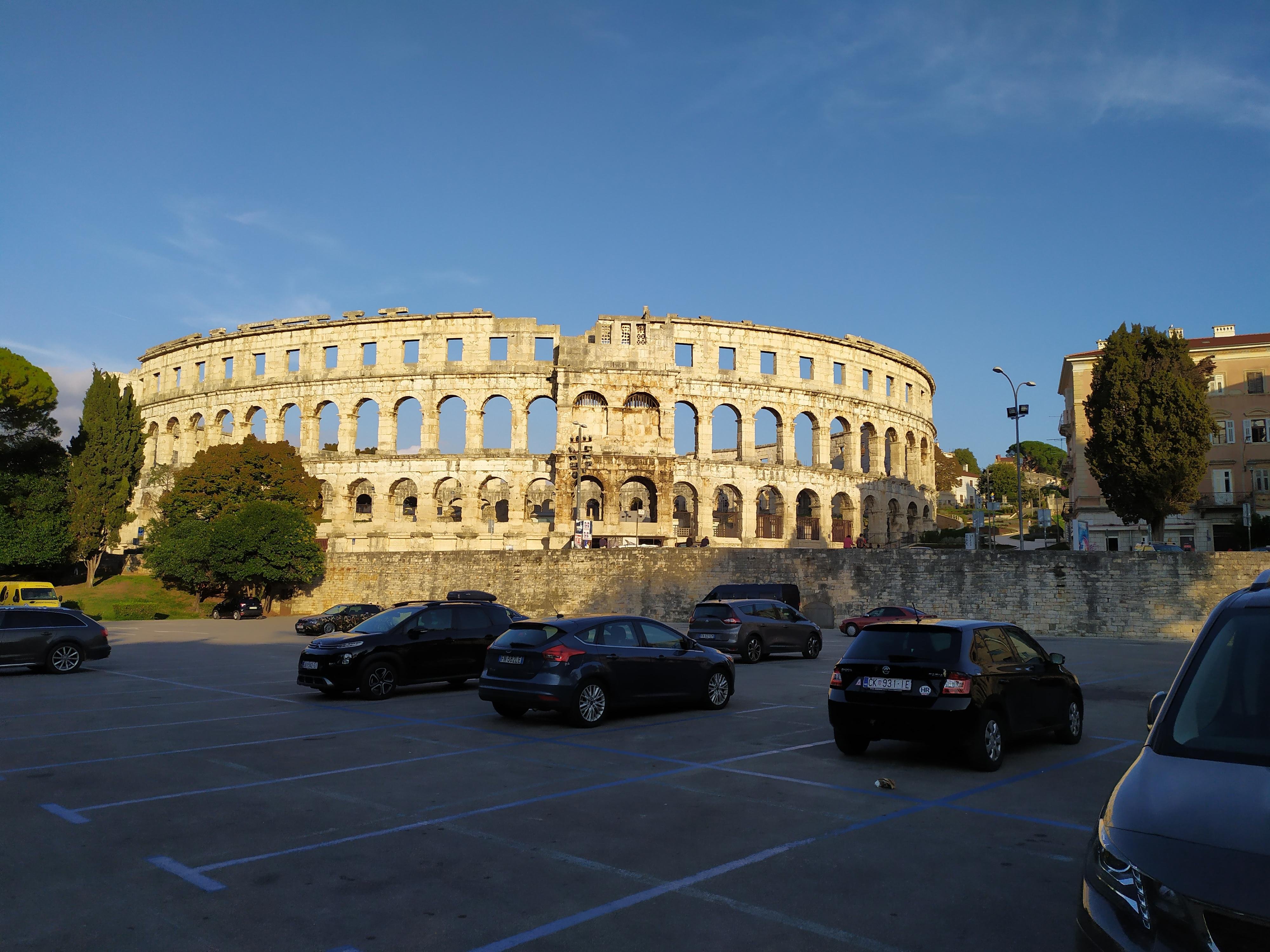
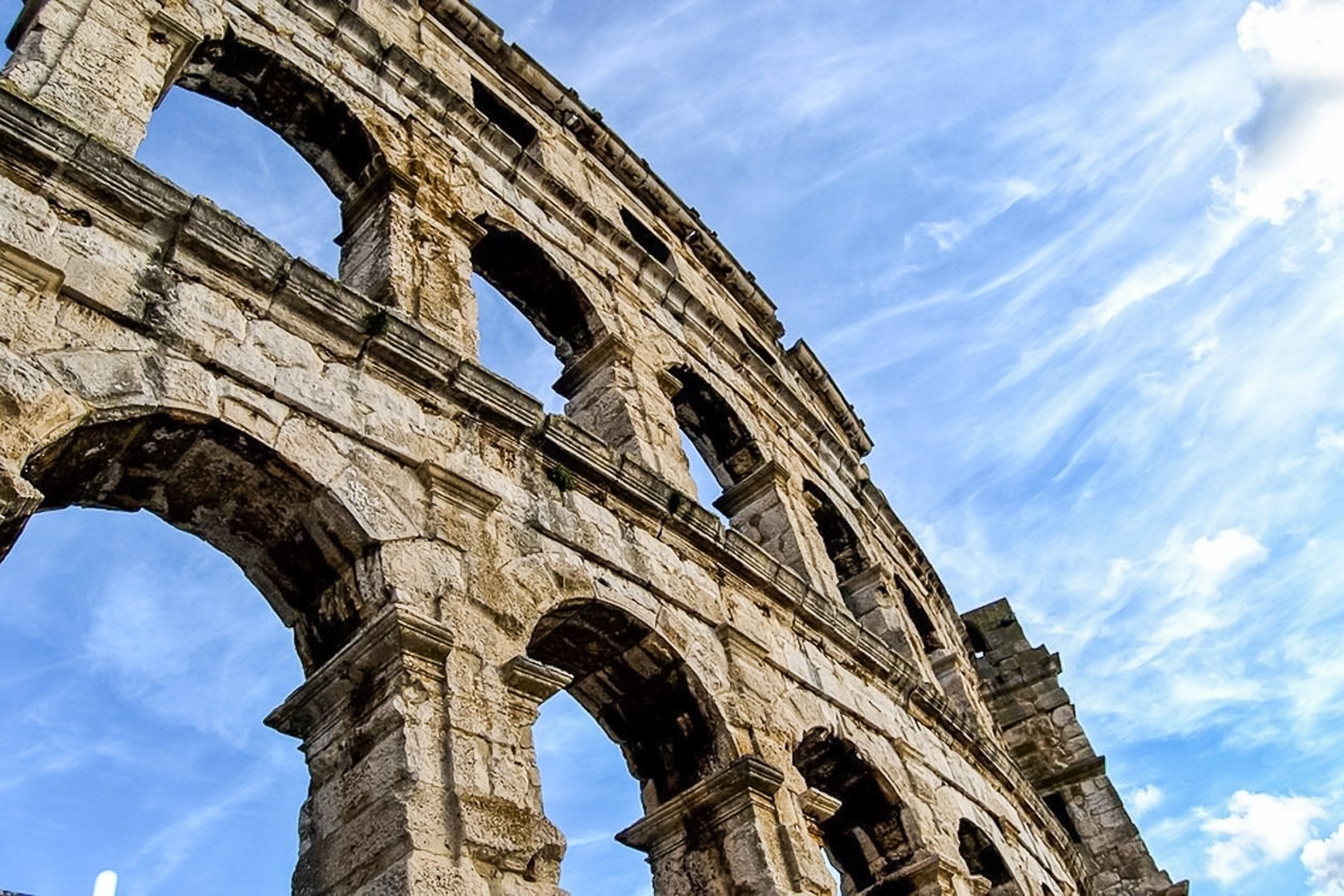
Amphitheater Pula
Tours & tickets

Hand-picked by our editors — only the best 5 experiences from 18 reviewed.

Open today 08:00–21:00
Attendance: Moderate — autumn shoulder season
The weather is mild, perfect for a Pula amphitheatre tour.
Free cancellation Instant confirmation Mobile voucher Skip-the-line Verified partner
Tickets

Choose your ticket

Verified partners for every tour, free cancellation where available, and instant confirmation on every booking.

Pula Arena Guided Tour with Entry 1 hr 15 min
Guided Experience

Pula Arena Guided Tour with Entry

★ 5 (5)
€70
per person
Instant Mobile voucher Flexible — change up to 24h

Explore one of Rome's best-preserved amphitheaters with an expert guide and underground access

Reserve
Brijuni Sunset Dolphin Cruise with Dinner & Drinks 3 hr
Premium Combo

Brijuni Sunset Dolphin Cruise with Dinner & Drinks

★ 4.6 (1525)
€35
per person
Instant Mobile voucher Flexible — change up to 24h

Three-hour evening voyage around Brijuni National Park watching for dolphins at golden hour aboard Europa

Reserve

Prices from verified partners. Availability updates in real time at checkout. Free cancellation policies apply where shown.

What you'll do

Inside a tour, step by step

  1. 01 15 min

    Arrival

    Reach the main gates to begin your Pula amphitheatre tour.

  2. 02 30 min

    Underground Passage

    Explore the subterranean area where gladiators waited.

  3. 03 45 min

    Main Arena Floor

    Walk the circle where historic combat once occurred.

  4. 04 30 min

    Outer Wall Observation

    View the exterior limestone facade and arches.

Highlights

What you'll see inside the attraction

The landmarks, rooms, and views travelers on this tour remember — all visible on a single visit.

Subterranean Passageway

See where gladiators and beasts were held before combat in this cool underground area.

Arena Floor

Stand in the center of the structure where spectators once cheered for historical events.

Outer Limestone Facade

Admire the four side towers and three stories of the iconic Roman masonry.

Seating Tiers

View the massive stone rows where thousands of Roman citizens watched public spectacles.

Head to head

Pula Arena vs. The Colosseum — Which Roman Pula Amphitheatre Tour Option Fits Your Trip?

The Colosseum offers unparalleled scale, while the Pula Arena provides an intimate setting that makes a pula amphitheatre tour significantly more manageable for casual history enthusiasts. Choosing between these Roman landmarks depends largely on whether you prefer a massive archaeological complex or a well-preserved, compact venue.

Feature Top pick Pula Arena The Colosseum
Scale
Massive
Crowd Density
Very high
State of Preservation
Partial ruins
Accessibility
Moderate due to congestion
Historical Context
Imperial capital hub
Price
18–24 EUR (varies)

Verdict: Securing pula amphitheatre tour tickets offers a relaxed experience of ancient architecture, whereas visiting the Roman rival demands more time and navigation of larger crowds.

How your ticket works

Book your ticket in 3 steps

  1. 01

    Book online

    Choose your ticket, select your date, and reserve in under two minutes. Secure checkout handled by our verified partner.

  2. 02

    Receive your mobile voucher

    Instant confirmation by email, with a mobile voucher you can save offline. No printing, no queuing at a collection desk.

  3. 03

    Show & enter

    Arrive at the entrance, show your voucher on your phone, and walk in. Most tickets include priority or skip-the-line access.

Plan your visit

Everything you need to know before you go

Practical details for your visit straight from our verified partners — hours, access, rules, and how to get there.

Open today · 08:00–21:00
Opening hours
08:00–21:00
Address
Flavijevska ul. bb, 52100, Pula, Croatia
Entry
Standard entrance fee 10 EUR
Best arrival
08:00–10:00
Storage
Not available on site
Contact
+385 52 219-028
Mon
08:00–21:00
Tue
08:00–21:00
Wed
08:00–21:00
Thu
08:00–21:00
Fri
08:00–21:00
Sat
08:00–21:00
Sun
08:00–21:00
Closed on: Jan 1 (New Year's Day), Dec 25 (Christmas Day)
Main entrance

Main Entrance

Flavijevska ul. bb

Gather at the ticket office for your Pula amphitheatre tour.

Address
Flavijevska ul. bb, 52100, Pula, Croatia
Storage
Not available on site
Contact
+385 52 219-028

How to get there

🚆
Public transport · 10 min · Minimal cost

Several local buses stop at the Pula main station nearby.

🚗
Car · Varies · Paid parking

Park at the public lot near the Pula Arena entrance.

🚶
Walk · 15 min · Free

The site is a short walk from the central Pula city center.

Dress code

Casual and comfortable clothing is recommended for a Pula amphitheatre tour. Wear sturdy walking shoes to navigate the uneven limestone surfaces safely.

Bags & security

Large backpacks and luggage are discouraged as there is no secure storage area. Security personnel may perform checks during your Pula Arena visit.

Photography

Photography is permitted for personal use throughout the monument. Professional filming equipment requires prior written authorization from the Pula amphitheatre tour management.

Accessibility

The central arena floor is accessible, but upper tiers involve steep stone steps. Guests with limited mobility should focus on the ground-level Pula amphitheatre tour routes.

Mobile phones

Mobile phones are permitted for photos and navigation. Please switch devices to silent mode to respect other visitors.

What to bring

  • Sunscreen
  • Hat
  • Water bottle
  • Comfortable walking shoes
  • Camera
  • Valid ID

Not allowed

  • Weapons
  • Sharp objects
  • Glass bottles
  • Alcohol
  • Drones
  • Professional tripods
  • Large luggage
  • Explosives
  • Aerosols

Families & strollers

The site is safe for children, though they must be supervised near the edge of the stone tiers. Strollers are difficult to maneuver on ancient Pula Arena flooring.

Food & drink

Food and beverages are not allowed inside the main Roman structure. Stay hydrated with water, but keep bottles stored in your bag during your Pula amphitheatre tour.

Pets

Only service animals are permitted inside the Pula Arena. Please leave household pets in secure accommodation.

Good to know

As the Pula Arena is a major historical site, please avoid touching or leaning on damaged structural elements. Respect the integrity of the limestone masonry.

Meeting point

Where to find us

Main Entrance

Flavijevska ul. bb

Gather at the ticket office for your Pula amphitheatre tour.

Get directions
Around your visit

Everything else worth knowing

Best time to go, insider tips, nearby landmarks, and the cancellation fine print — flip through to skim what matters to you.

Best time to visit

How crowds, weather, and events shift across the year.

Spring

Mild temperatures allow for comfortable walking across the stone tiers.

Helpful tips for your visit

Small details that turn a good visit into a great one.

Beat the crowds

Plan your Pula amphitheatre tour between 08:00–10:00 to avoid large groups.

Nearby landmarks

Non-bookable sights within a short walk — free to visit, easy to pair.

Temple of Augustus

5 min

A well-preserved Roman temple located in the nearby forum.

Arch of the Sergii

8 min

An ancient Roman archway featuring intricate carvings.

Twin Gates

10 min

Historic Roman gates providing access to the old town.

Floor Mosaics

12 min

Ancient Roman mosaics discovered in the city center.

Cancellation policy

Flexible, no hidden fees.

Tickets for the Pula Arena are generally non-refundable once purchased. Ensure your schedule aligns with the 10 EUR entrance fee before completing your booking.

Where to stay

Hotels & districts near the attraction

Hand-picked options within walking distance — pick a district for vibe, or a specific hotel for convenience.

Hotel Amfiteatar

2 min
mid-range

Conveniently located directly opposite the Roman arena.

Park Plaza Histria

15 min
luxury

A seaside resort offering modern amenities and comfort.

Old Town Apartments

10 min
boutique

Charming units situated in the historic city center.

About

The place, in context

The Pula Arena stands six storeys tall along the Adriatic coast, its white limestone walls concealing a singular engineering feat: the amphitheatre was constructed over intersecting bedrock ridges that would have forced most Roman architects to flatten the terrain. Instead, first-century engineers carved four subterranean levels directly into the uneven stone, creating cellars and passageways that turned geological inconvenience into structural advantage. The result is the world's only surviving Roman amphitheatre with all four side towers intact, each originally capped with wooden machinery that hoisted canvas awnings across 23,000 spectators. Built during the reign of Emperor Vespasian between 68 and 79 CE, the arena hosted gladiatorial combat until the fifth century, when Emperor Honorius banned the contests. Medieval Pula dismantled much of the interior seating for building material, yet the outer walls endured through Venetian rule, Austrian occupation, and two world wars. Austrian-era restorations in the 1800s stabilized the arches; a 1932 overhaul removed crumbling capstones and reinforced the underground chambers, which now house permanent exhibitions on Roman viticulture and olive oil production along the Istrian peninsula. The amphitheatre's elliptical footprint measures 132 metres along its major axis, with travertine blocks joined by iron clamps rather than mortar. Seventy-two ground-level arches framed the original entrances; today, visitors enter through the eastern gate, where archaeologists uncovered fragments of marble revetment that once lined the podium wall. The underground museum displays amphorae recovered from shipwrecks off the Brijuni archipelago, funerary steles inscribed in Latin, and iron tools used in arena maintenance. Summer evenings transform the floor into an open-air concert venue, with the stone reflecting acoustic clarity that baroque opera houses spent centuries trying to replicate. Guided tours of the Pula Arena interpret the graffiti etched into backstage corridors by Roman stagehands, the drainage channels that flushed animal waste into the Adriatic, and the trapdoor mechanisms that delivered wild boars and Carpathian bears into the fighting oval. Conservation work completed in 2019 reopened the northwest tower, where a narrow spiral staircase climbs to the upper arcade. From that vantage, the Croatian coastline stretches south toward Premantura, and the Kvarner Gulf frames the amphitheatre against the open sea.

"The world's only surviving Roman amphitheatre with all four side towers intact."
Your experience

What a tour day looks like

A step-by-step walkthrough of the visit — what you'll see, how long each stage takes, and the details that matter.

You approach the arena from Flavijevska Street, where the outer wall rises abruptly from the pavement, its arches casting geometric shadows across the limestone. You purchase your ticket at the eastern entrance and step through the vaulted corridor into sudden daylight. The oval spreads before you, its sandy floor enclosed by reconstructed timber seating and the skeletal outline of podium walls. You descend the modern staircase into the underground chambers, where dim lighting reveals rows of earthenware jars, olive presses, and informational panels explaining Roman agricultural exports. You walk the perimeter of the arena floor, pausing at the gladiator exhibition near the southwest gate. Replica armor and short swords rest behind glass, accompanied by diagrams of combat formations. You climb the stone steps to the second tier, where the acoustics shift: voices from the floor reach you undistorted, a reminder of the sightlines engineered for 23,000 spectators. If you've reserved a guided tour, your interpreter explains the iron rings embedded in the walls, once used to secure the velarium poles that shaded the crowd. You exit through the northern gate as the afternoon sun backlights the towers, the Adriatic visible between the arches. The entire visit spans ninety minutes if you linger in the museum; sixty if you prioritize the arena floor and upper arcade.

Frequently asked

Frequently asked questions about pula amphitheatre tour tours

What are the opening hours for a Pula amphitheatre tour?

The Pula Arena is open daily from 08:00–21:00.

How much are the Pula amphitheatre tour tickets?

Standard Pula amphitheatre tour tickets cost 10 EUR per person.

Is the Pula Arena wheelchair accessible?

While the central floor of the Pula Arena is accessible, the tiered seating is difficult for wheelchairs.

When is the best time to start a Pula amphitheatre tour?

Start your Pula amphitheatre tour between 08:00–10:00 to avoid the heat.

Can I take photos during a Pula amphitheatre tour?

Yes, you can take personal photos during your Pula amphitheatre tour.

Are there lockers for bags during a Pula amphitheatre tour?

No, the Pula Arena does not provide lockers for guest use.

Is food allowed inside the Pula Arena?

No food or drink is permitted inside the Pula Arena structure.

How do I get to the Pula amphitheatre tour?

The Pula amphitheatre tour is accessible by bus, taxi, or walking from the city center.

Are children allowed on a Pula amphitheatre tour?

Yes, children are welcome on a Pula amphitheatre tour if supervised.

What is the cancellation policy for Pula amphitheatre tour tickets?

Pula amphitheatre tour tickets are non-refundable as per standard site policy.