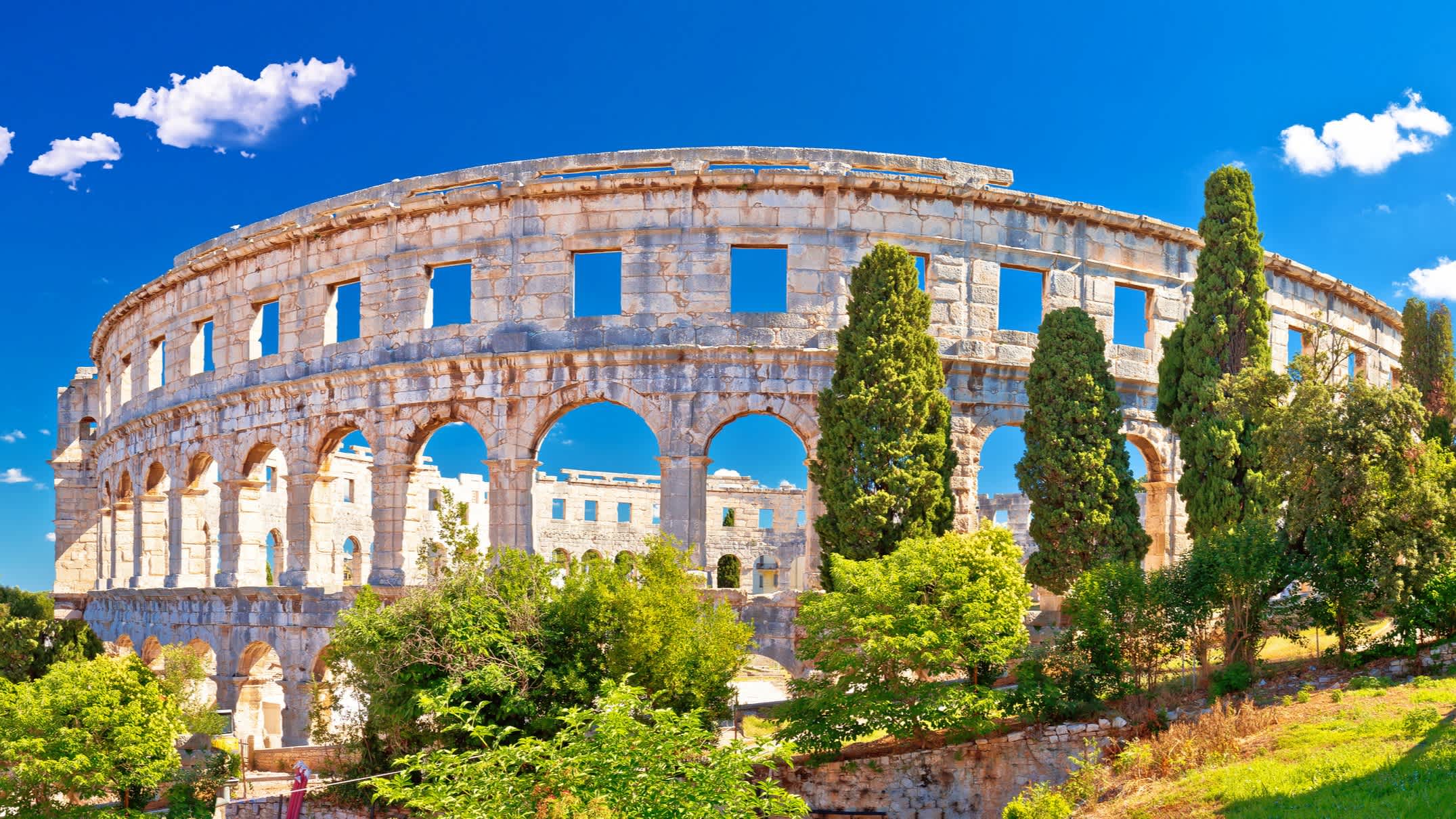
Outer Walls
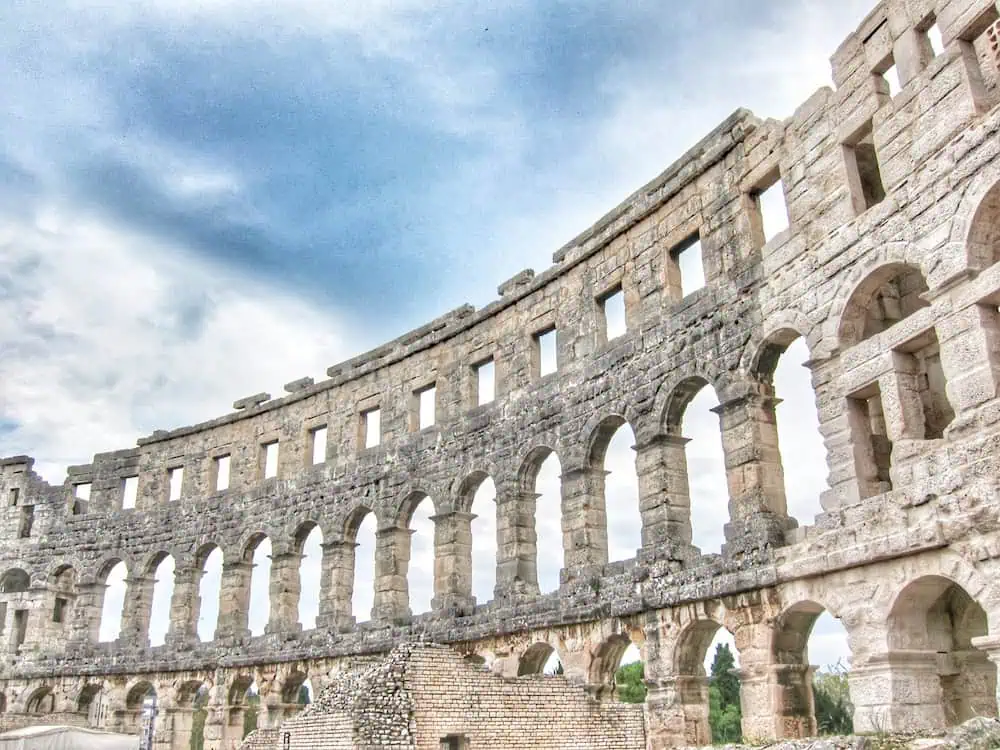
The outer facade stands as one of the best-preserved examples of Roman amphitheater construction, featuring three levels of arches.
Observe the limestone blocks from the exterior for clear architectural details.

The amphitheater in Pula stands as the sixth-largest surviving Roman arena and the only one preserving all four side towers intact. Built under Emperor Vespasian in the first century AD, it served gladiatorial combat, naval reenactments, and public spectacle for fifteen thousand spectators. Today it anchors Pula's old town as a UNESCO candidate site and active cultural venue.
Quick answer
The Pula Arena was constructed between 27 BC and 68 AD, with major expansion completed under Emperor Vespasian around 79 AD during the Flavian dynasty. The structure replaced an earlier wooden amphitheater and was built to serve the Roman colony of Pietas Julia, hosting gladiatorial games, animal hunts, and mock naval battles. Its limestone blocks were quarried locally from the Istrian peninsula, and the elliptical design measures 133 by 105 meters with a seating capacity of approximately fifteen thousand.
The amphitheater Pula Geschichte begins not with a single foundation stone but with three successive structures on the same site outside the city walls. The earliest wooden arena dates to Augustus, expanded twice before Vespasian ordered the permanent limestone monument that survives today. Construction followed the standard Flavian blueprint—elliptical plan, three-story arcade, underground chambers—but Pula's version adapted to sloping coastal terrain by embedding the lower tiers into the hillside and elevating the upper arcade on massive substructures. Gladiatorial combat ceased in the fifth century, and the arena passed through Byzantine, Venetian, and Austro-Hungarian control. Each regime repurposed the stones: medieval lords quarried blocks for fortifications, and proposals in the sixteenth century nearly saw the entire structure dismantled and rebuilt in Venice. Local resistance preserved it. By the nineteenth century, Austrian engineers restored the outer wall and cleared rubble from the arena floor, establishing the conservation framework still in use. Today the amphitheater Pula Geschichte extends beyond ancient Rome. The underground passages that once held gladiators and animals now house a permanent exhibition on olive oil production and Roman viticulture in Istria, connecting the monument to regional agriculture. Summer concerts and the Pula Film Festival occupy the arena floor, seating modern audiences where Roman citizens watched executions and staged hunts. The four corner towers, unique among surviving amphitheaters, originally collected rainwater and distributed it through terracotta pipes—an engineering refinement that speaks to Pula's role as a strategic naval base rather than a provincial backwater. The stone itself tells a stratigraphic story: limestone from Vinkuran, sandstone from local quarries, and Roman concrete binding the interior vaults. Graffiti scratched into the seating blocks records spectator names, betting odds, and obscene taunts, preserved under centuries of coastal weathering. Conservation teams monitor salt erosion from Adriatic winds and calibrate interventions to protect both the ancient fabric and twentieth-century restorations without freezing the monument in a single historical moment.
“Local resistance in the sixteenth century saved the arena from dismantling, preserving what Austrian engineers would later restore as the most complete Flavian amphitheater outside Italy.”
Das Amphitheater in Pula entstand in mehreren Bauphasen während der frühen römischen Kaiserzeit. Die erste Holzkonstruktion wurde unter Kaiser Augustus um 27 v. Chr. errichtet, als Pula zur römischen Kolonie aufstieg. Diese frühe Arena diente bereits gladiatorischen Kämpfen und öffentlichen Spektakeln, die das römische Herrschaftssystem in der istrischen Provinz festigten. Unter Kaiser Vespasian zwischen 68 und 79 n. Chr. erfolgte der monumentale Ausbau in Stein. Die Baumeister verwendeten lokalen istrischen Kalkstein und errichteten die charakteristische elliptische Form mit einer Länge von 132 Metern und einer Breite von 105 Metern. Die Fassade erreichte eine Höhe von 32 Metern und umfasste vier Stockwerke mit 72 Bögen. Die unterirdischen Gänge und Kammern, in denen Gladiatoren und wilde Tiere vor den Kämpfen warteten, wurden ebenfalls in dieser Phase angelegt. Das Bauwerk fasste etwa 20.000 Zuschauer und zählte damit zu den größten Amphitheatern des Römischen Reiches. Nach dem Verbot der Gladiatorenkämpfe durch Kaiser Honorius im Jahr 404 n. Chr. verlor die Arena ihre ursprüngliche Funktion. Im Mittelalter diente sie als Steinbruch für andere Bauvorhaben in Pula, während die Bevölkerung Teile der Struktur für Wohnbauten nutzte. Im 13. Jahrhundert diskutierten venezianische Patrizier den vollständigen Abriss und Transport der Steine nach Venedig, doch lokaler Widerstand verhinderte diesen Plan. Die moderne Erhaltung der amphitheater pula geschichte begann im 19. Jahrhundert unter österreichischer Herrschaft. Zwischen 1816 und 1932 erfolgten systematische Restaurierungen, die das antike Erscheinungsbild wiederherstellten. Heute steht die Arena als besterhaltenes römisches Amphitheater außerhalb Italiens. Besucher können die originalen Sitzreihen, die unterirdischen Korridore und die vollständig erhaltene Außenmauer besichtigen, die das architektonische Erbe römischer Ingenieurskunst dokumentiert.
Kaiser Augustus gründet die römische Kolonie Pietas Iulia und lässt eine erste Holzarena errichten
Unter Kaiser Vespasian entsteht der monumentale Steinbau mit vier Stockwerken und 72 Bögen
Kaiser Honorius verbietet Gladiatorenkämpfe im gesamten Römischen Reich, die Arena verliert ihre Funktion
Venezianische Patrizier planen den Abriss, lokaler Widerstand der Bürger Pulas verhindert die Demontage
Der venezianische Senat ordnet Schutzmaßnahmen für die verbliebene Struktur an
Österreichische Verwaltung führt systematische Restaurierungen durch und sichert die antike Bausubstanz
Die Arena wird offiziell als archäologisches Denkmal klassifiziert und für Besucher geöffnet
Das Amphitheater dient als Museum und Veranstaltungsort, die unterirdischen Gänge zeigen Ausstellungen zur römischen Geschichte
The Pula Arena is open daily throughout the week, including weekends, to accommodate visitors.
The Pula Arena is located at Flavijevska ulica, 52100 Pula, Croatia, situated within the heart of the city center. It is easily accessible on foot from the historic old town or via local bus lines connecting to the nearby Pula bus station.
From Pula City Center to Flavijevska ulica
Lines 1, 2, or 3 to the Arena stop
Parking available near the Riva and surrounding streets
Drop-off at Flavijevska ulica
For the most comfortable experience, plan your arrival between 08:00 and 10:00 to avoid larger crowds. Parking is limited in the immediate vicinity, so consider utilizing public transport or walking from the city center.
To experience the site with minimal congestion and favorable conditions, plan your arrival between 08:00–10:00. This early window allows for a thorough exploration before the primary influx of daily visitors.
—
This period offers the quietest environment for visitors. It is ideal for those who prefer a calm pace and fewer people during their visit.
Mild temperatures 20°C–25°C
These months avoid the intense heat and heavy crowds of the peak summer season. You will find more space to move around the corridors.
Hot temperatures 28°C–32°C
Expect heavy attendance and warm conditions during these months. Arriving exactly at 08:00 is essential to avoid the afternoon peak.
Verdict: The best time to visit is during the shoulder months of May or September, arriving promptly at 08:00 on a weekday.
The Pula Arena offers visitors the opportunity to explore distinct architectural remains that provide insight into Roman engineering and public life. Key features include the expansive outer walls and the subterranean areas once used during events.
The outer facade stands as one of the best-preserved examples of Roman amphitheater construction, featuring three levels of arches.
Observe the limestone blocks from the exterior for clear architectural details.
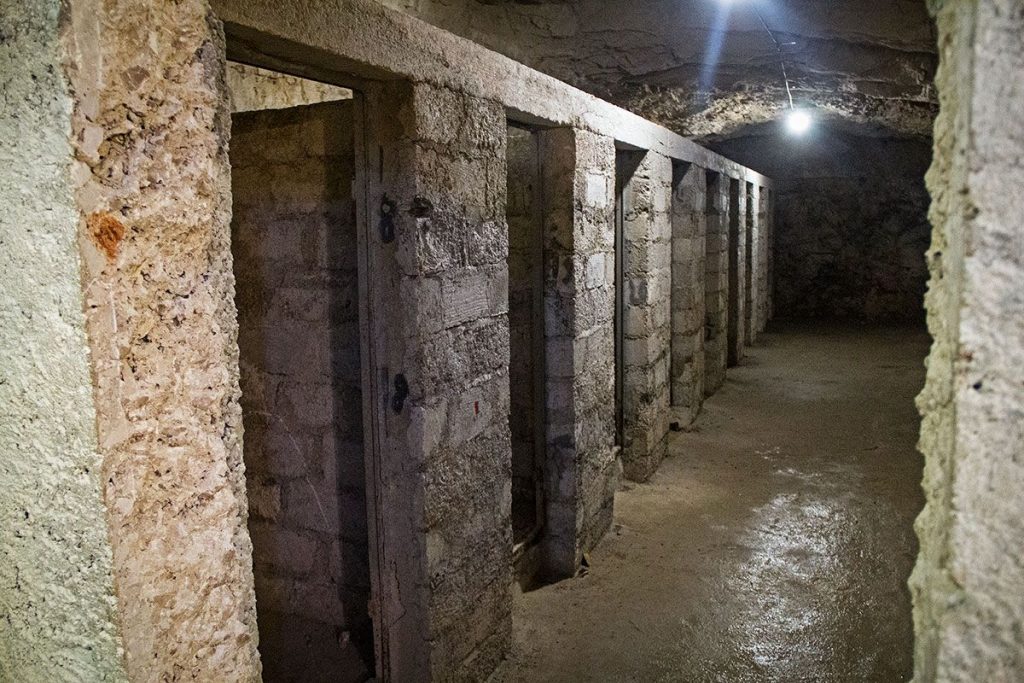
Located beneath the arena floor, these chambers previously housed gladiators and animals before they entered the main stage.
Walk through these corridors to understand the logistics of ancient spectacles.
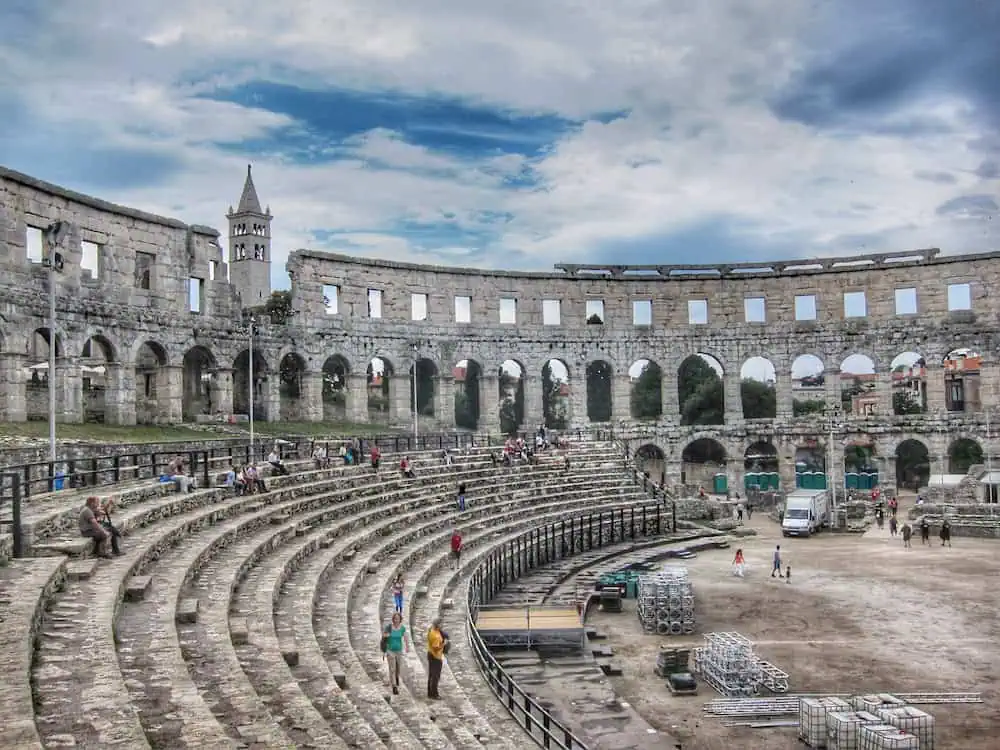
This tiered seating area allowed thousands of spectators to view the games held in the center of the arena.
Find a high point to visualize the scale of the original seating.
Everything you need to know about amphitheater pula geschichte
The amphitheater pula geschichte, also known as the Pula Arena, is one of the best-preserved Roman amphitheaters in the world, dating back to the 1st century AD. It was built during the reign of Emperor Vespasian to host gladiator contests and other public spectacles.
While visitors can explore the site independently, information panels provide context about the site's Roman architecture and the gladiatorial battles that once took place here. Researching the amphitheater pula geschichte beforehand can help you better appreciate the limestone structure and subterranean passages.
The entrance fee is 10 EUR, which acts as a conservation fee per person for foreign adults. This fee supports the ongoing maintenance of the structure and the surrounding historical grounds.
The best arrival window is 08:00–10:00, which allows you to experience the site with fewer crowds and more comfortable temperatures. Visiting early in the morning is highly recommended for a relaxed exploration of the amphitheater pula geschichte.
The site is open daily from 08:00–21:00, including weekends. This generous schedule provides flexibility for planning your visit to this important Croatian landmark.
The Pula Arena is generally accessible for families with children, though the uneven terrain of the ancient stone floors requires careful walking. It is a great way to introduce younger visitors to the amphitheater pula geschichte and the broader history of the Roman Empire.
Visitors should arrive with comfortable footwear to navigate the ancient masonry and stairs safely. As a prominent site of Roman engineering, it remains a focal point for those interested in historical preservation in Croatia.